Threat Model
← BackThis page presents the system context and Level 1 data flow diagram used to scope the threat modelling, alongside STRIDE (security) and LINDDUN (privacy) analysis outputs for the Accessible Authentication & Account Recovery prototype.
For an explanation of framework selection and MS-specific adaptations, view the threat modelling rationale.
Figure 1 — System Context Diagram
Actors, trust boundaries, and external dependencies for authentication and recovery.
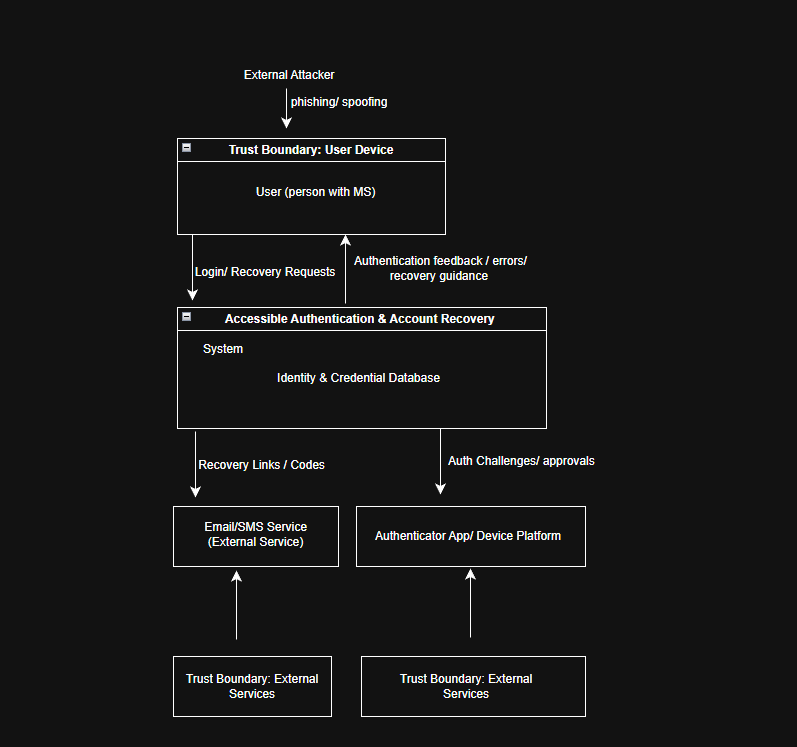
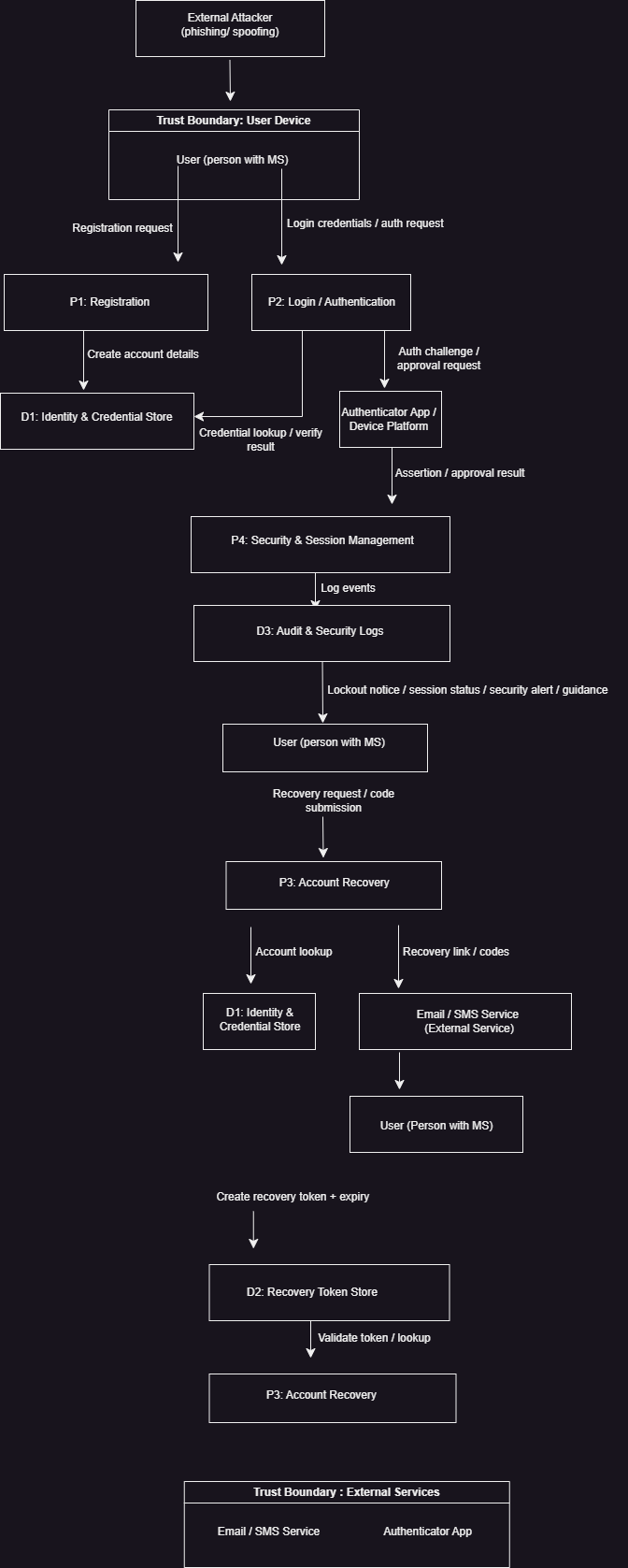
Figure 2 — Level 1 Data Flow Diagram
Processes (P1–P4), data stores (D1–D3), and flows for registration, login, recovery, and session management.
Threat Analysis Outputs
The following sections can be expanded or collapsed. Use Tab to focus a section heading, then press Enter or Space to toggle.
STRIDE was applied to each process and major data flow to identify security threats and mitigation actions, with emphasis on risks that disproportionately affect users with MS (e.g., phishing susceptibility, lockout spirals).
- Key focus: phishing/spoofing, lockout/DoS, recovery takeover, session hijacking.
- Inclusive design lens: reduce cognitive load, improve error recovery, provide alternative pathways.
LINDDUN was used to evaluate privacy threats such as account detectability, linkability across channels, and user unawareness—especially during recovery flows.
- Key focus: account detectability, exposure via recovery channels, transparency and consent.
- Mitigation themes: uniform responses, minimised data, clear privacy feedback and explanations.